
Storefront Door Lock Repair in Newmarket
Retail glass entrances on Davis Drive, Main Street South and the plazas along Mulock. Doors that will not latch, keys that will not turn, hardware that has been pushed a hundred thousand times.
Quick answer
Storefront door lock repair in Newmarket usually starts with alignment, not the lock. Worn pivots, a sagging bottom rail or a closer pulling the door out of square stop a deadlatch from catching. Typical repairs run $180 to $430 including parts, most finished in one visit. Call 866-820-1331.
Almost every storefront door lock repair call in Newmarket starts the same way. The owner says the lock is broken. Nine times out of ten the lock is fine and the door has moved. A glass and aluminum entrance is a light frame carrying a very heavy piece of glass, hung on two small pivots, being yanked open and slammed shut several hundred times a day, in a climate that swings from minus twenty-five to plus thirty-three.
It moves. The bottom rail drops a couple of millimetres, the top pivot wears, the closer arm gets adjusted by whoever could reach it, and one morning the latch no longer lines up with the strike. The key still turns. The bolt still throws. It just does not go anywhere useful.
So the first thing a technician does on a retail entrance is stand there and watch the door close. Where it binds, where it rubs, whether it rebounds off the stop, whether the gap at the top is the same as the gap at the bottom. That five-minute look is the difference between a $220 adjustment and an unnecessary $500 of new hardware.
The classic Newmarket failures on a retail entrance
Four problems account for most of the calls we get from shops and restaurants in town.
Bottom rail sag
The corner joints in an aluminum door loosen over years and the door racks out of square. The lock edge drops, the latch misses the strike, and the door drags on the threshold. Usually correctable by re-squaring and tightening the corner assembly.
It only happens in July
Thermal expansion. Aluminum grows with heat, the frame and door grow at different rates, and a door that latched fine in April binds by mid-summer. A strike adjustment of a millimetre or two normally fixes it for good.
Worn pivots and hinges
Offset pivots and centre-hung pivots wear at the bearing. The whole door drops and swings toward the frame. New pivots are cheap; ignoring them wrecks the lock and eventually the glass seal.
The deadlatch itself
Deadlatches do fail — the auxiliary plunger seizes, the spring weakens, the latch tail rounds off. When that is genuinely the fault, replacement is quick and the door is trading again in under an hour.
There is a fifth one worth naming: the door somebody propped open all summer with a rubber wedge. That kills closers and pivots faster than anything else on a shopfront. If you need the door held open, use a proper hold-open arm on the closer rather than a wedge.
Deadlatch, hookbolt or deadbolt — what should be on your door?
Retail entrances in Newmarket carry one of three locking arrangements, and shop owners are often running the wrong one for the door they have.
A deadlatch is the everyday choice on a swinging aluminum door. It has a spring latch plus a small auxiliary plunger that rides on the strike face and deadlocks the latch so it cannot be shimmed with a credit card. It lets staff pull the door shut behind them and it is locked. That convenience is why it is on most shopfronts.
A hookbolt is for sliding doors and for pairs of doors where the meeting stiles have nowhere to throw a straight bolt into. The bolt swings out and hooks around a keeper. It resists being forced apart in a way a straight bolt on a slider never can.
A deadbolt, in aluminum door language usually an MS-style bolt, throws a long solid bolt into the frame or the threshold. It is the strongest of the three and the least convenient, because it has to be keyed or thumbturned every time. Plenty of shops run a deadlatch for the day and throw the deadbolt at close. That is a sensible combination and it is what we recommend for most independent retailers.
- Deadlatch for daytime trading and staff coming and going
- MS-style deadbolt thrown at close for overnight security
- Hookbolt where the door slides or where a pair of doors meet
- Mortise cylinder outside, thumbturn inside so nobody is ever locked in
- Cylinder guard or armoured ring where the door faces a laneway or back alley
- Nothing on the inside that needs a key to get out — see egress below
Keeping the door legal to exit through
This one matters more than the lock. A door people leave a building through has to open from the inside without a key, without special knowledge, and in a single motion. That is the principle behind every egress requirement, and it is the thing fire inspectors look at first on a retail unit.
What that rules out in practice: keyed cylinders on the inside face of a public entrance, thumbturns that have been removed because staff kept locking the door mid-shift, slide bolts and padlocks added at the bottom of the door, and chains draped through a pair of handles at close and forgotten in the morning. We see all four in Newmarket shops, and all four are a problem if anything ever goes wrong.
Where a shop genuinely needs the door locked against entry while people are inside, the answer is a deadlatch or an exit device that always retracts from the inside push, not a bolt somebody has to find a key for. Your fire inspector or the local authority having jurisdiction is the final word on what your particular unit needs, and we would rather you ask them than take our word for it. What we will do is fit hardware that does not create the problem in the first place.
Storefront door lock repair prices in Newmarket
Most shopfront calls resolve inside ninety minutes. The wide ranges below are mostly about which parts turn out to be needed, and you will know that before the technician starts.
| Repair | Typical time | Price range (CAD) |
|---|---|---|
| Diagnose and adjust so the door latches | 30 – 60 min | $110 – $190 |
| Strike plate adjustment or replacement | 20 – 40 min | $90 – $160 |
| Deadlatch replaced, standard commercial | 45 – 90 min | $220 – $430 |
| MS-style deadbolt supplied and fitted | 1 – 2 hrs | $290 – $560 |
| Hookbolt lock for a sliding or paired door | 1 – 2 hrs | $320 – $620 |
| Mortise cylinder replaced and keyed | 20 – 30 min | $120 – $210 |
| Offset or centre pivots replaced, per pair | 1.5 – 3 hrs | $380 – $780 |
| Re-square a sagging aluminum door | 1 – 2 hrs | $220 – $420 |
| Threshold or door sweep replaced | 45 – 90 min | $180 – $360 |
| Emergency secure after a forced entry | 1 – 2 hrs | $180 – $450 |
Ranges are typical for Newmarket in 2026 and cover labour plus standard commercial-grade parts. Overnight, weekend and statutory holiday call-outs carry a premium. A firm price is confirmed on the phone before a technician is dispatched.
Shopfronts we work on around town
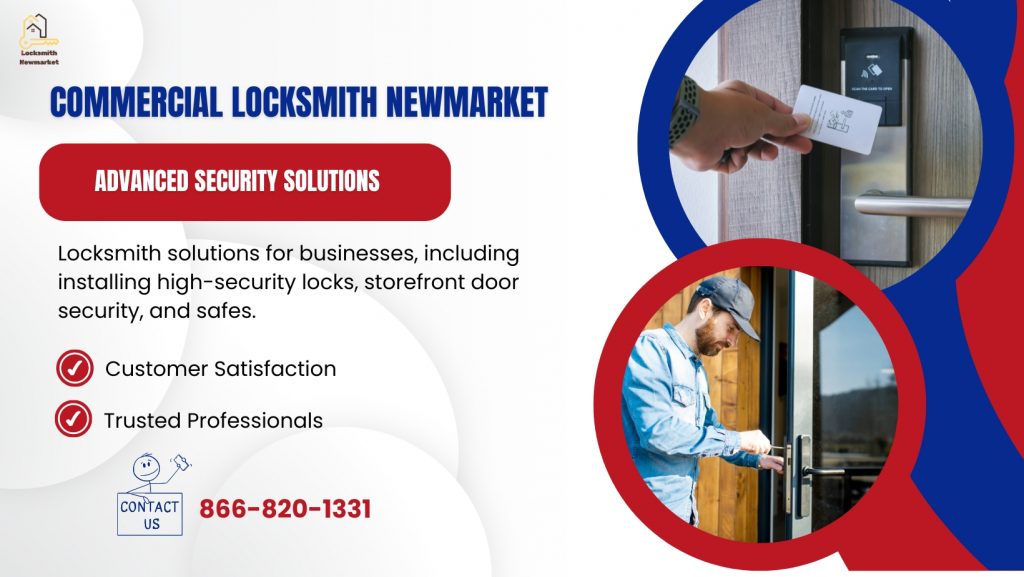
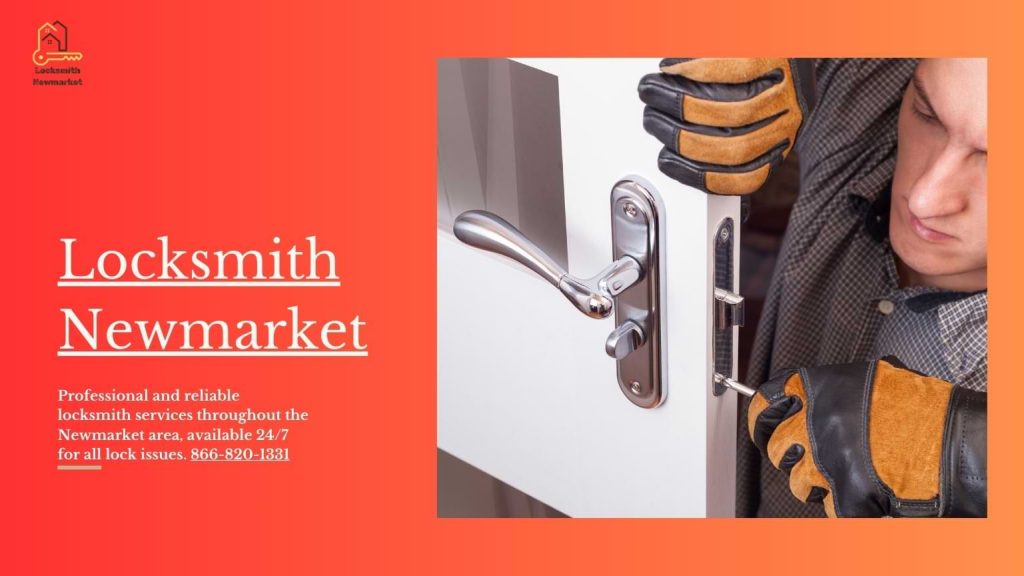
The independent retail on Main Street South is mostly older stock — narrow-stile aluminum doors in masonry openings, some of them thirty years old, with hardware that has been repaired three times already. The plazas along Davis Drive and Mulock Drive run newer medium-stile doors, which take a wider range of hardware but sag just as happily. Restaurants are their own category: heavy use, grease on everything, and a back door that matters as much as the front.
If the whole door is aluminum framing and you are trying to work out whether the lock or the door is the problem, the detail is on our aluminum door lock repair page. If somebody has already forced the door, start with burglary damage repair.
Why shop owners call us for the front door
Retail door repair across the region
Beyond Newmarket we cover shopfronts in the surrounding towns. Everything runs from the Newmarket base, so out-of-town calls carry a little more drive time.
Frequently asked questions
Why does my shop door only stick in the summer?
Thermal expansion. Aluminum grows measurably as it heats, and a door in direct afternoon sun can be several degrees hotter than the frame around it. A door set with almost no clearance in winter will bind in July. The fix is normally a small strike adjustment plus checking the closer is not holding the door hard against the stop.
The key turns but the door will not open. What is wrong?
The cylinder is doing its job and the linkage past it is not. On aluminum doors that is usually a worn or wrong-length tailpiece, a loose cam screw, or a latch that has jammed because the door is out of alignment and the plunger is caught on the strike lip. All three are quick fixes once diagnosed.
Can you repair my door or does it need replacing?
Most doors are repairable. Sagging corners can be re-squared, pivots and hinges are replaceable, and hardware is a bolt-on item. A door only really needs replacing when the stiles are cracked around the lock pocket or the frame itself has been damaged in a forced entry. We tell you honestly which one you are looking at.
How fast can you get to a shop that will not lock?
Inside Newmarket, typically 20 to 30 minutes from dispatch, any hour of any day. A retail unit that cannot secure at close is treated as an emergency. If a part has to come the next morning we still make the door lockable before we leave.
What does storefront door lock repair cost in Newmarket?
A diagnose-and-adjust visit that gets the door latching again runs $110 to $190. A replacement deadlatch with labour is $220 to $430. Pivot replacement, which is a bigger job, runs $380 to $780 a pair. You get a firm number before the work starts.
Is it legal to padlock the inside of my front door at night?
Once the building is empty and locked from outside, that is a different situation from trading hours. What you must never do is lock people in with a device that needs a key from the inside while staff or customers are present. Your fire inspector or the local authority having jurisdiction sets the requirement for your unit — ask them, and fit hardware that keeps you clear of the question.
Can you fit a buzzer so we can release the door from the counter?
Yes. An electric strike wired to a button at the till is a common retail setup, and it works alongside your existing deadlatch. There are fail-safe and fail-secure versions and the choice matters on an exit door. The detail is on our electric strike installation page.
Do you work on restaurant back doors as well?
Yes, and they need more attention than most. Back doors take steam, grease and constant use, and they are frequently the door that has been propped open with a milk crate for three years. Expect closers, pivots and latches to wear faster there than at the front.
Related locksmith services in Newmarket
Get your shop door latching again today
Describe what the door is doing — will not latch, key spins, drags on the floor — and we will tell you what it usually is before we drive out. Call 866-820-1331, 24 hours a day.