
Cylinder Locks in Newmarket: Types, Sizing and Replacement
Euro profile, rim, mortise and key-in-knob cylinders, how the pins inside actually work, and how to measure one so the replacement fits the first time.

Quick answer
A lock cylinder is the keyed core, the barrel the key slides into and turns. Newmarket doors use four common formats: euro profile, rim, mortise and key-in-knob. In most cases the cylinder can be replaced or rekeyed on its own for far less than a whole new lock, as long as the format, length and cam match exactly.
The cylinder is the small brass or nickel barrel the key slides into. Everything else on the lock, the handle, the bolt, the latch, the decorative trim, is mechanical hardware that a push button could operate just as well. The cylinder is the only part that decides whether your key, and no other key, gets to move it. So most sensible conversations about cylinder locks in Newmarket end up being about the cylinder by itself rather than the lock as a whole.
That distinction saves people money. A lock body is a manufactured assembly with a finish, a backset and a set of screw holes that have to line up with the door. A cylinder is a small standardised part. Swapping one is often a fifteen minute job with no drilling and no change to the appearance of the door.
This page covers the four cylinder formats you are likely to find on a Newmarket door, how a pin tumbler works, what anti-snap and anti-drill features genuinely resist, and the measuring method that prevents the most common do-it-yourself failure we get called out to fix. If what you actually want is fresh keys rather than new hardware, rekeying the cylinders you already have is nearly always the cheaper route.
The four cylinder formats on Newmarket doors
Identify the format before you buy anything. Almost every wrong purchase starts here.
Walk down a street in Glenway Estates and then down Main Street South and you will see two different eras of hardware. Newer builds and anything with a multipoint patio or side door tend to run euro profile. Older stock, storefronts and apartment entries run rim and mortise. Knowing which one is in your door takes ten seconds once you know what to look for.
Euro profile
The flat oval-over-rectangle shape, held by a single long screw through the edge of the door. Standard on multipoint doors, most patio and garden doors, and a lot of newer entry sets. Comes as double, single, or single with a thumbturn.
Rim cylinder
A round cylinder that mounts through the door with two screws and drives a flat tailpiece into a surface-mounted lock on the inside face. Common on older apartment doors and on jimmy-proof deadbolts downtown.
Mortise cylinder
A threaded round cylinder that screws into a lock body buried inside the edge of the door, driving a cam rather than a tailpiece. Standard on commercial storefronts along Davis Drive and on century homes.
Key-in-knob and key-in-lever
The cylinder sits inside the knob or lever itself. Also the format used in most residential deadbolts, where it is called a KIK cylinder and is held in by a clip or a cam plate.
One practical point. Euro cylinders are sized in millimetres and are not interchangeable between doors. Rim and mortise cylinders are sized in fractions of an inch and mortise cylinders also vary by cam shape. A KIK cylinder for a Schlage deadbolt will not drive a Kwikset one. Format alone is not enough, you need the size and the drive part to match too.
How a pin tumbler cylinder actually works
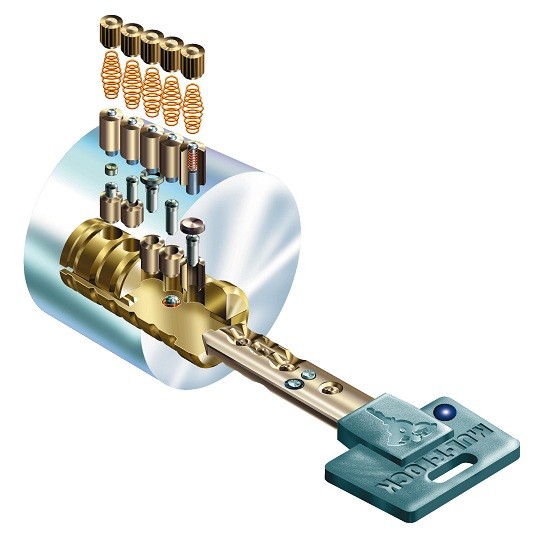
Nearly every cylinder in a Newmarket home is a pin tumbler. Inside the outer housing is a rotating plug. Drilled through both, in a straight line, are five or six vertical chambers. Each chamber holds a spring, a driver pin on top and a key pin underneath.
At rest, the plug is locked
The springs push the driver pins down so they straddle the gap between plug and housing. Steel crossing that gap means the plug physically cannot rotate.
The key lifts each stack
The cuts along the blade are different depths. Each cut lifts its own pin stack by a precise amount, which is why a key that is close but not right will still refuse to turn.
The shear line clears
When every stack is lifted so the joint between key pin and driver pin sits exactly at the plug edge, nothing is crossing the gap any more. That line is called the shear line.
The plug turns and moves the bolt
Rotation drives a cam, a tailpiece or a lug, which is what actually throws the bolt or retracts the latch. The cylinder itself has no security value once it is turning.
Two things follow from that. First, rekeying works because you can pull the plug, drop in a different set of key pin heights and hand over a new key without touching the door at all. Second, wear matters. Ten or fifteen years of grit and a slightly worn key gradually round off the pin tips, and the day the key finally stops turning is usually the day after it started feeling sticky. Sticky is your warning. Call before it becomes a lockout on your own front step.
Anti-snap and anti-drill cylinders, and what those features really resist
Manufacturers put a lot of words on cylinder packaging. It is worth knowing what each feature actually stops, because two of them matter a great deal on some doors and not at all on others.
Anti-snap
A deliberate weak groove near the front of the cylinder. Grip the protruding nose with pliers, snap it, and the sacrificial section breaks away while the working core stays in the door with the cam still protected. This only matters on euro cylinders, and it only matters if the cylinder sticks out past the handle escutcheon.
Anti-drill
Hardened steel or ceramic inserts sitting in front of the pin stacks and in the plug face. A drill bit skids off them or dulls instead of cutting through the pins. It buys time and makes noise, which is usually enough.
Anti-pick and anti-bump
Spool, mushroom or serrated driver pins. They catch on the plug edge under tension and give a false set instead of a clean one, which defeats casual raking and makes bump keys unreliable. Good high security cylinders add sidebars or a second row of pins on top of this.
Key control
Not an attack resistance feature at all. A restricted keyway means the blank is patented and no hardware store or kiosk can cut a copy. It stops keys multiplying quietly rather than stopping a break-in.
Here is the blunt version. If your euro cylinder is flush or nearly flush with the handle plate, anti-snap adds very little because there is nothing to grip. If it protrudes more than about three millimetres, it is worth every dollar. And on a wooden door in a wooden frame, none of it matters as much as the frame does, which is the argument made in full on our high security lock upgrade guide.
How to measure a euro cylinder correctly
This is where most people go wrong, and it is easy to get right.
A euro cylinder is described as two numbers, for example 35/45. Those are the two halves measured from the centre fixing screw hole outwards, not from the ends of the door and not the total length. The single most common mistake is measuring the whole cylinder, dividing by two and ordering a symmetrical one. That gives you a cylinder that protrudes on one side and sits recessed on the other, which either fouls the handle or leaves a snappable nose sticking out.
Take the cylinder out first if you can
Open the door, remove the single long screw in the edge of the door below the latch, put the key in and rock it a few degrees each way until the cam lines up, then pull the cylinder out. Measuring in place is guesswork.
Find the centre screw hole
There is a threaded notch in the middle of the cylinder body where the fixing screw passes through. That notch is your zero point for both measurements.
Measure the outside half, then the inside half
From the centre of that notch to the outer face, and from the centre of that notch to the inner face. Round to the nearest 5 mm. Euro cylinders come in 5 mm steps starting at 30 mm per side, so 30/30, 35/30, 40/45 and so on.
Write it in the right order
Convention is outside first, inside second. Get it backwards and you will fit a cylinder that sits proud on the street side and flush indoors, which is exactly the wrong way round.
Aim for flush outside
The outer face should finish level with the handle escutcheon or no more than a hair proud. Indoors you have more freedom, and a slightly longer inner half is fine if you are fitting a thumbturn.
If you are ordering online rather than having us fit it, measure twice and photograph the old cylinder alongside a tape measure. A 5 mm error is the difference between a lock that works and one that will not accept the fixing screw.
Replacing just the cylinder, and when that is not possible
Most of the time you can leave the lock alone and change only the cylinder. It is faster, cheaper and it keeps the finish on the door matching. On a euro door it is genuinely one screw. On a residential deadbolt the KIK cylinder comes out with a clip once the inside plate is off. On a storefront mortise lock the cylinder unscrews once the set screw in the edge of the door is backed off.
- Cylinder-only swap works when the lock body itself is sound and the bolt still throws smoothly by thumbturn
- It works when you want a different keyway, a restricted key or an upgrade in pick and drill resistance without new hardware
- It works when you want the front, back and garage to run on one key, which is a keying job rather than a hardware job
- It does not work when the lock body is worn and the bolt drags, binds or has to be lifted into place
- It does not work when the door has moved and the bolt no longer lines up with the strike, which is a fitting problem, not a cylinder problem
- It does not work when the cylinder has seized inside the housing and has to be extracted, which can damage the lock case on the way out
- It does not work on some multipoint gearboxes with proprietary cams, where the maker sells cylinder and gear together
If the lock body is the problem rather than the cylinder, you are into replacing the hardware itself, and it is worth doing that properly rather than nursing a worn lockcase along for another winter. A seized or dragging bolt in November will be a jammed bolt in January.
Cylinder lock prices in Newmarket
Cylinder work is one of the cheaper things a locksmith does, which is why it is worth asking about before you agree to a full lock replacement. These are typical 2026 ranges for Newmarket, Aurora and East Gwillimbury addresses.
| Job | What it covers | Typical price |
|---|---|---|
| Euro cylinder supplied and fitted | Correct sizing, standard cylinder, three keys | $110 – $180 |
| Anti-snap euro cylinder supplied and fitted | Hardened, snap-resistant, anti-drill core and keys | $180 – $320 |
| Rim or mortise cylinder replacement | Cylinder, correct cam or tailpiece, adjustment | $120 – $220 |
| Key-in-knob or deadbolt KIK cylinder | Cylinder, keys, refit and function check | $90 – $160 |
| Keying several cylinders alike | Front, back and garage on one key | $25 – $55 per extra cylinder |
| Seized or snapped cylinder extraction | Non-destructive removal where possible, plus replacement | $160 – $300 |
Ranges are typical for Newmarket in 2026 and cover parts and labour on a standard door. Overnight, weekend and statutory holiday call-outs carry a premium. A firm price is confirmed on the phone before anyone is dispatched.
Why Newmarket calls us first
Cylinder work across Newmarket and the towns around it
Most cylinder calls come from Newmarket itself, the newer subdivisions off Mulock and Leslie, the townhouse blocks near Yonge and Davis and the older stock around Main Street South and Fairy Lake. We also cover the surrounding towns from the same base, usually within the half hour.
Frequently asked questions
What is the difference between a lock and a cylinder?
The lock is the whole assembly on the door, including the bolt or latch, the handle and the plates. The cylinder is only the keyed barrel inside it. Changing the cylinder changes which key works. Changing the lock changes the hardware itself. On most doors you can do the first without doing the second, and it costs a fraction as much.
How do I measure a euro cylinder?
Measure each half from the centre of the fixing screw hole to the outer face, not the whole length divided by two. Write the outside figure first, the inside second, for example 35/45. Euro cylinders step in 5 mm increments. The outer face should finish flush with the handle plate rather than sticking out.
Can you change the cylinder without changing the whole lock?
Usually yes. If the bolt still throws smoothly and the lock body is sound, we swap the cylinder only. That keeps the finish on your door consistent and saves most of the cost. The exceptions are worn lock bodies, misaligned bolts and a few proprietary multipoint gearboxes that are sold with their cylinder as one unit.
Is an anti-snap cylinder worth paying for?
It depends on how far the cylinder protrudes. If it sits flush with the handle escutcheon there is nothing to grip and the benefit is small. If it stands proud by more than about three millimetres, an anti-snap cylinder is one of the best value upgrades on the door. We will tell you which situation you are in when we see it.
Should I rekey the cylinder or replace it?
Rekey if the hardware is in good order and you simply want the old keys to stop working, after moving in or losing a key. Replace if the cylinder is worn, if the key has started to stick, or if you are moving up to a higher grade of pick and drill resistance. Our page on rekeying versus replacing goes through both cases.
Why has my key started to stick in the cylinder?
Nearly always wear plus contamination. Grit and winter salt work into the keyway, the pin tips round off and a slightly worn key stops lifting each stack to exactly the right height. Never use oil, it holds dust. A dry graphite or PTFE lubricant helps. If it still sticks, the cylinder wants repinning or replacing before it strands you outdoors.
Can all my exterior doors use one key?
Yes, provided the cylinders share a keyway. We pin the front, back, side and garage cylinders to a single key on site. If one door uses a different brand we can usually change that cylinder to match rather than change the whole lock. It is the same process described on our rekeying locks page.
Do you carry cylinders on the van?
Common euro sizes, KIK cylinders for the usual residential deadbolt brands, rim cylinders and mortise cylinders in the standard cams all travel with the technician. Restricted and high security cylinders are ordered in, which normally takes a couple of business days.
Related locksmith services in Newmarket
Not sure which cylinder your door takes?
Send a photo or describe the shape over the phone and we will tell you the format and the likely size before anyone is dispatched. Call 866-820-1331, any hour, any day of the year.