
Master Key System Installation in Newmarket
One key for the manager, one key per tenant, and a written keying schedule before a single pin is cut. Master key systems designed, installed and maintained across Newmarket since 2000.

Quick answer
A master key system lets one key open many doors while each individual key opens only its own. The levels run from the grand master key at the top, through master and sub-master keys, down to the change key on each door. The system is drawn up as a written keying schedule first, and only then are the cylinders pinned to match it.
Most master key systems that fail were never really designed. Someone asked a locksmith to make five doors work off one key, the pins were shimmed until they did, and three years later the plaza has fourteen doors, nine keys that half work, and nobody who can say which key opens what. A proper master key system in Newmarket starts on paper — a door schedule, a hierarchy, and deliberate spare capacity — and moves to the pinning bench afterwards.
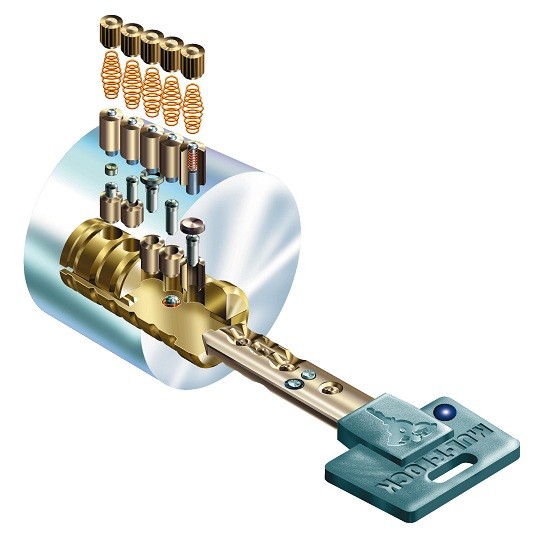
The mechanical idea underneath it is simple. Inside a pin tumbler cylinder every chamber holds a bottom pin and a top driver. Add a third, thinner pin between them — a master wafer — and that chamber now has two heights at which the plug will turn. One height belongs to the change key for that door. The other belongs to a key higher up the hierarchy. Repeat that across a few chambers and you have a cylinder that two, three or four different keys will open, each of them legitimately.
We have been building and maintaining these systems for Newmarket offices, plazas, clinics and industrial units since 2000. Some are eight doors inside a single tenancy on Mulock Drive. Some run to a couple of hundred cylinders across several buildings. The design discipline is identical either way, and so is the reason it matters: the system you install today has to absorb staff turnover, a lost key and a tenant fit-out in year three without being torn out and started again.
The four levels, in plain terms
Grand master, master, sub-master, change key. Read it from the top down and it stops being jargon.
Every key in a master system sits at a level, and the level is defined by what the key opens rather than by anything you can see on it. A change key and a grand master key can look identical lying on the counter. What separates them is the keying schedule that says so.
- Grand master key (GMK) — opens every cylinder in the whole system. Usually one or two exist. The owner, or the principal, and nobody else.
- Master key (MK) — opens everything within one building or one department. The property manager or the general manager carries it.
- Sub-master key (SMK) — opens a defined group of doors: one tenancy, one floor, one clinical wing, every mechanical room.
- Change key (CK) — the ordinary key that opens one door and nothing else. Most people in a building only ever hold one of these.
- Maintenance or cross key — a change key deliberately given one or two extra doors, such as a caretaker who needs the mechanical room and the bin enclosure but nothing else.
A system only needs the levels it actually uses. A four-unit plaza with an absentee owner does not need a grand master sitting above the master. That extra level burns key capacity, adds master wafers to every cylinder, and creates a key that is almost impossible to keep track of. More wafers mean a cylinder that picks more easily and wears faster. Design down to the fewest levels that do the job, not up to the most levels the keyway allows.
A worked example: a medical office near Davis Drive
Nine doors, ten people who need different access, one key each.
Take a family practice in one of the professional buildings near Davis Drive and Southlake. The suite has a corridor entrance, a reception and records room, four exam rooms, a treatment and lab room, a locked medication cupboard room, a staff room, and a mechanical and electrical closet. The landlord holds a key to the suite entrance. Four physicians, six clinical staff, two administrative staff and a cleaner all need to get into different parts of it, and one of them arrives at nine in the evening.
| Door | Who carries a key | Level |
|---|---|---|
| Suite entrance from the corridor | Landlord, clinic manager, all staff, cleaner | Opens to the GMK, the MK, both sub-masters and its own change key |
| Reception and records | Clinic manager, two admin staff | Administrative sub-master |
| Exam rooms 1 to 4 | Physicians, clinical staff | Clinical sub-master |
| Treatment and lab room | Physicians, clinical staff | Clinical sub-master |
| Medication cupboard room | Two named physicians only | Its own change key, plus the master |
| Staff room | Everyone on payroll | Cross keyed to both sub-masters |
| Mechanical and electrical closet | Landlord, cleaner | Change key, plus the grand master |
Now count what leaves the building at the end of the day: one grand master with the landlord, one master with the clinic manager, two sub-masters, and a change key for everyone else. Ten people, five distinct key types, nine doors. If a clinical sub-master goes missing, the four exam rooms and the lab get rekeyed — seven cylinders, an hour and a half of work — and the rest of the system carries on untouched. That containment is the entire point of drawing the system before pinning it.
The cleaner carries a single change key that also turns the corridor entrance. She cannot open records, the exam rooms or the medication room, and nobody has to hand her a master key at nine at night.
How the system is designed before a single pin is cut
Walk the building and write a door schedule
Every opening gets a number, a location, a lock type and a note on the door itself — hollow metal or wood, cylindrical or mortise, existing keyway, condition of the strike and frame. This is an hour or two with a clipboard, and it is the cheapest hour in the whole project.
Group the doors by who uses them
Not by floor and not by corridor. By function: who needs to be in this room at seven in the morning, who needs it at eleven at night, and who must never be in it at all. The groups you draw here become the sub-masters.
Choose the keyway and reserve capacity
A commercial keyway offers a finite number of usable change key cuts once the master levels have been pulled out of it. We deliberately leave thirty to fifty percent of the system unassigned so that year three has somewhere to go without disturbing what already works.
Write the keying schedule and have it signed
A table of door numbers against key symbols — AA, AB, AA1 and so on. The client reads it, argues with parts of it, and signs it. Every argument settled at this stage is one that does not happen later with a pinning kit open on the counter.
Pin, stamp, cut and hand over
Cylinders are pinned to the schedule at the bench, stamped with their key symbol on the face or the cam, installed, and then tested on every door with every key that should open it and a few that should not. Keys are cut, tagged, serialised and issued against the register.
That last test is the step cheap operators skip, and it is not optional. A master system is only proven once somebody has physically put the wrong key in the wrong door and watched it refuse to turn. If your installer hands you a bag of keys without walking the building with you, the system has not been verified.
Key control: the register is the system
A master key system with no record of who holds what is an expensive way of giving everyone access to everything. Key control is the administrative half of the job, it costs almost nothing, and it is the half that decides whether the system is still trustworthy in year five.
A signed key register
Key symbol, the serial stamped on the bow, holder name, date issued, date returned, signature. Paper in a binder is perfectly fine. A spreadsheet nobody has updated since the install is not.
Restricted keyways
On a patented profile the blanks are not sold to the public and duplicates are only cut against a signed authority. That turns do-not-duplicate from a request into something enforceable. See restricted key systems.
Serialised keys
A unique number on every key means a found key traces back to a named holder, and the annual audit takes twenty minutes rather than an afternoon of guesswork.
Stamped cylinder records
Marking each cylinder with its key symbol means a technician arriving five years from now can rebuild a damaged cylinder straight from the schedule instead of stripping half the building to read it.
Departing staff are the everyday test of key control. If a manager leaves holding a master and you cannot say with certainty that it came back, the correct response is to rekey that master level — which on a well-designed system means a handful of cylinders rather than the whole building. Where the risk is higher, or where turnover is constant, putting an electronic layer such as fob-based access control on the main entrance lets you cancel a credential in ten seconds instead of cutting metal.
Master keying, rekeying and the bench work behind it
Almost all of the skill in a master system is invisible by the time you see it. What the client sees is a key that works. What produced it is a chart, a pinning kit and a lot of small decisions about which chamber carries which wafer.

What goes wrong, and why cheap master keying costs more by year three
There are a handful of ways a master system goes bad, and only one of them is the lock hardware’s fault.
- No spare capacity. The system was pinned to exactly the doors that existed on the day. The tenant adds a storage room, there is no free change key left in that group, and the locksmith either starts cross keying badly or re-pins doors that were working perfectly.
- Too many levels. Five levels in a twelve-door building means four or five master wafers stacked in some chambers. Those cylinders pick easily, they wear, and eventually a change key starts turning a door it should not. That is a genuine security failure that presents as a random fault.
- Mixed keyways. Half the building on one profile because someone bought replacement hardware at a big-box store mid-project. Nothing masters cleanly after that and every future door becomes a negotiation.
- No schedule on file. The original locksmith kept the chart in his head or on a laptop and no longer answers the phone. Rebuilding an undocumented system means physically reading every cylinder — a full day of labour the original design should have made unnecessary.
- Keys with no owner. Twenty-two keys issued, eleven accounted for. Every unaccounted master is a rekey waiting to happen, and the longer it waits the more it costs.
Priced on the day, a properly designed system runs a few hundred dollars more than a bag of make-these-all-the-same rekeys. Priced across five years it is cheaper by a wide margin, because a designed system absorbs a lost key, a new tenancy or a departing manager as a small, contained job. Rebuilding a badly designed one rarely comes in under a thousand dollars once labour, replacement cylinders and cut keys are added up — and it usually happens at the worst possible moment, which is why we also handle emergency commercial lock changes around the clock.
What master key work costs in Newmarket
Master keying is priced on cylinder count and design time rather than as a flat package, because a nine-door clinic and a forty-door plaza are not the same job. These are typical 2026 ranges for commercial work in Newmarket and the surrounding York Region towns.
| Work | Typical range (CAD) | Notes |
|---|---|---|
| Site survey and written keying schedule, up to 20 doors | $150 – $350 | Usually credited against the installation |
| Rekey an existing cylinder into the system | $28 – $55 per cylinder | Plus the service call |
| New commercial Grade 2 cylinder, supplied and keyed | $60 – $130 each | Rim, mortise or key-in-knob |
| Restricted or patented cylinder keyed into the system | $95 – $180 each | Includes the signed duplication authority |
| Cut, stamp and register additional keys | $6 – $18 standard · $12 – $30 restricted | Per key |
| Expand an existing system, per added door | $70 – $160 | Assuming capacity was reserved at design |
| Chart and rebuild an undocumented legacy system | $450 – $1,200+ | Reading and recording every existing cylinder |
These ranges are typical rather than quotes. Overnight, weekend and statutory holiday call-outs carry a premium. A firm price is confirmed on the phone before a technician is dispatched.
Why Newmarket plazas and offices keep their keying chart with us
Master key systems across Newmarket and York Region
Most of our master key work sits inside Newmarket — the professional buildings around Davis Drive and Southlake, the small-business plazas on Mulock Drive and Leslie Street, and the industrial units off Harry Walker Parkway. Response to a Newmarket address is typically 20 to 30 minutes, and design work is booked rather than dispatched.
We also design and maintain systems for buildings in the surrounding towns. The technician drives from the Newmarket base, so add the honest drive time to the response figure for anywhere outside town.
Frequently asked questions
What is the difference between a master key and a grand master key?
A master key opens every door within one building or one department. A grand master key sits one level above that and opens every door in the entire system, including several buildings or several tenancies if that is how the system was drawn. In a single-building system you often do not need a grand master at all, and adding one just for the sake of it makes every cylinder slightly weaker.
Does master keying make my locks less secure?
Slightly, and it is worth being honest about it. Every master wafer added to a chamber creates a second turning point, which gives a picker more to work with and adds a small amount of wear. A well-designed system with two or three levels on a good commercial cylinder is still perfectly secure for an office or a plaza. A five-level system crammed into a cheap keyway is not. That is why we design down rather than up.
Can you master key the locks I already have?
Often yes, if they are commercial-grade cylinders on a keyway that supports masters and they are in reasonable condition. Worn cylinders and most residential-grade knob sets are better replaced than mastered, because a chamber that is already sloppy plus a master wafer equals a key that turns when it should not. We check the existing hardware during the survey and tell you which cylinders are worth keeping.
What happens if a master key is lost?
You rekey the level that key controlled, not the whole building. On a system with proper sub-masters, a lost clinical sub-master might mean six or seven cylinders and a couple of hours. A lost grand master means everything, which is exactly why grand masters should exist in ones and twos and be signed for. Call as soon as you know it is gone — we run 24 hours a day.
How long does a master key system take to install?
For a typical Newmarket office suite of eight to fifteen doors, the survey and schedule take a day, and the pinning and installation take another half day to a full day once the hardware arrives. Larger plazas are staged over a week so tenants are never locked out of their own units. Rush work is possible; it just costs more.
Can I add doors to the system later?
Yes, and that is the main reason to have it designed properly. If capacity was reserved at the design stage, a new door is a new cylinder pinned to a free change key symbol — usually seventy to a hundred and sixty dollars including the visit. If no capacity was reserved, adding a door can force a re-pin of an existing group, which is the expensive version of the same request.
Do I need a restricted keyway for a master system?
Not always, but it is the single upgrade that most often pays for itself. Standard commercial blanks can be copied at any hardware counter, which means your carefully drawn hierarchy is only as good as the honesty of everyone holding a key. A restricted profile means duplicates are cut only against a signed authority on file. It adds roughly thirty to sixty dollars per cylinder.
Can a master key system work alongside fobs and cards?
That is how most modern buildings are set up. The perimeter and high-traffic doors run on electronic access control, so credentials can be issued and cancelled instantly, while interior doors, cupboards and mechanical rooms stay mechanical and sit inside the master system. Every access control door still needs a mechanical override cylinder, and that cylinder should be keyed into the master hierarchy too.
Related locksmith services in Newmarket
Have a keying schedule drawn for your building
Tell us how many doors you have and who needs to get through them. We will walk the building, draw the hierarchy, and price it before anything is pinned. Call 866-820-1331 — 24 hours a day, in Newmarket since 2000.