
Restricted Key System in Newmarket
Patented keyways that a hardware store cannot duplicate, a signed authorisation list you control, and a master key hierarchy designed on paper before a single cylinder is cut.

Quick answer
A restricted key system in Newmarket uses patented key blanks that cannot be bought or copied at a hardware store. Keys are only cut against written authorisation from a person you nominate. Cylinders run roughly $95 to $180 each and keys $18 to $45. Call 866-820-1331.
Here is the uncomfortable thing about ordinary keys. Anyone holding one can walk into a hardware store or a kiosk in Upper Canada Mall and have three copies cut in four minutes for eight dollars. No question asked, no record kept. Your key policy is whatever your least careful employee decides it is.
A restricted key system closes that. The blank itself is a patented product, sold only through authorised locksmiths, with the physical blanks controlled and the design protected. A copy can only be cut by an authorised dealer, and only against a signature from a named person on your authorisation list. When somebody walks in claiming to be from your company, they get a phone call to you, not a key.
That is the whole idea, and it is unglamorous. There is no app, no subscription, no battery. It is a mechanical answer to a mechanical problem, and for a lot of Newmarket businesses it is a better fit than an access control system costing five times as much.
What restricted actually means
The word gets used loosely. There are three tiers and they are not equivalent.
Standard keyway
Blanks sold to anyone. Copied anywhere, including by machines in supermarkets. Fine for a garden shed, poor for a business with staff.
Restricted keyway
Blanks distributed only to authorised dealers under contract. Copying requires going to that dealer with authorisation. No patent behind it, so it depends on the distribution agreement holding.
Patented keyway
The blank and key profile are protected by an active patent. Making an unauthorised blank is a legal matter, not just a policy matter. The strongest form of key control available mechanically.
High security cylinder
Often combined with the above: hardened inserts, anti-drill pins, anti-pick sidebars. Key control and physical attack resistance are separate features, and you can buy either without the other.
Worth being clear on that last point. Key control stops copying. It does not by itself stop someone attacking the cylinder with a drill. Most patented systems also come with hardened cylinders, which is why they are sold together, but if physical attack is your concern read the high security locks page too. And note that patents expire. A system whose patent lapsed in 2019 is a restricted system, not a patented one, and the blanks eventually appear on the aftermarket.
Key control in practice: who can cut a key
Setting up a system is only half of it. The half that determines whether it works is the paperwork, and it is genuinely simple.
When your system is created, you nominate the people who may authorise key cutting — usually an owner, an office manager and one backup. Their signatures go on file with us, along with your system code and a card or ID number issued to you. Anyone requesting a key must present that authorisation. No signature, no key, regardless of how convincing the story is.
What that means day to day: the employee who wants a spare front door key cannot get one on their own. The contractor who lost the key you lent them cannot quietly replace it. The former manager who kept an old key cannot have duplicates made. And if a key does go missing, you know exactly how many exist because every one that was ever cut is recorded against your system.
- Two or three named signatories, no more — a long list defeats the point
- A written key register showing every key issued, to whom, and on what date
- Keys stamped with a code that is meaningless to anyone but the system holder
- Never stamp an address, a suite number or the word master on a key
- An annual count where every issued key is physically accounted for
- A defined process for a lost key: who is told, and whether the affected level gets rekeyed
Designing a master key hierarchy
Most restricted systems in Newmarket are also master key systems, because if you are going to design the keying properly you may as well do the whole thing at once. The structure has three common levels and one that appears in larger buildings.
A change key is the bottom level. It opens one door, or one small group of doors, and nothing else. This is what most staff carry — the key to their own office, or the key to the unit they work in.
A master key sits above a group of change keys and opens all of them. In an office suite that might be the manager key that opens every interior door. In a plaza it might be the key for one tenant unit that opens the front door, the stockroom and the rear exit.
A grand master key sits above several masters. A property manager holding one can open every unit in the building. Above that, in very large systems, a great grand master covers multiple buildings — and if you are genuinely at that level, the design work matters even more, because the mathematics of available key combinations gets tight.
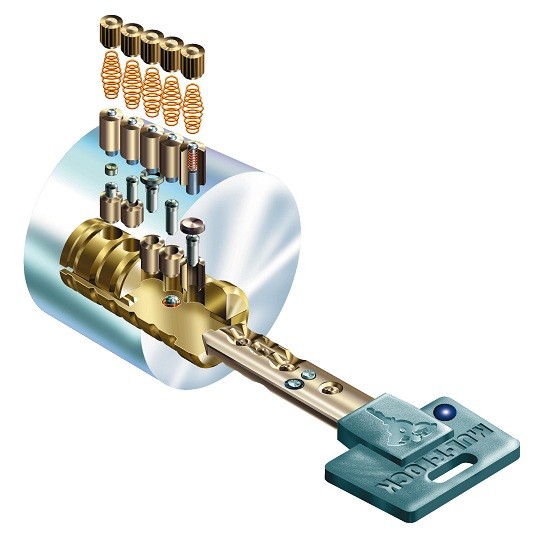
That last point is the reason design comes first. Every master pin added to a cylinder creates additional shear lines, which means additional keys that will accidentally operate it. A system designed carelessly with too many levels produces cross-keying — keys that open doors they were never meant to — and you will not discover it for two years. A system laid out properly on paper, with expansion room deliberately left in it, does not have that problem. Our master key system installation page goes further into the mechanics.
Survey and door schedule
Every opening numbered and listed, with what hardware is on it and who needs to pass through it. Usually an hour or two on site.
Design the chart on paper
Levels defined, groups decided, expansion allowance built in for the doors you have not added yet. Nothing is cut at this stage.
You approve it
You read the chart in plain language — this key opens these doors — and sign off before any money is spent on cylinders.
Cut, pin and issue
Cylinders pinned to the chart, fitted, tested against every key level, and keys issued and recorded against named holders.
When a small business genuinely needs one
We are not going to pretend every business needs this. Plenty do not. Here is the honest split.
You probably need a restricted system if: you have had a key go missing and you do not know where; staff, cleaners or contractors hold keys and turn over regularly; you store client records, controlled products, cash or high-value stock; you are a landlord or property manager responsible for other people access; or you have simply lost track of how many keys exist for your front door.
You probably do not need one if: two or three long-standing people hold keys and always have; the premises are inside a controlled building with its own entry system; or the only thing behind the door is a desk and a kettle. In those cases a straightforward rekey to a standard keyway is the right spend and we will say so.
There is also a middle path worth mentioning. Some businesses put restricted cylinders only on the openings that matter — the front door, the record room, the stock cage — and keep standard cylinders on interior doors. That gets most of the benefit at a fraction of the cost, and for a small office it is often the sensible answer.
Restricted key system prices in Newmarket
Two costs to plan for: the setup, and the ongoing cost of keys. The second one surprises people, so it is worth looking at before you commit.
| Item | Detail | Price range (CAD) |
|---|---|---|
| System design and keying chart | Survey, chart, sign-off | $180 – $650 depending on size |
| Restricted mortise cylinder | Supplied and fitted | $95 – $180 each |
| Restricted rim or key-in-knob cylinder | Supplied and fitted | $85 – $165 each |
| Restricted deadbolt, complete | Supplied and fitted | $180 – $340 each |
| Change key | Cut to your system | $18 – $32 each |
| Master or grand master key | Cut to your system | $25 – $45 each |
| Add a door to an existing system later | Cylinder plus pinning | $110 – $210 per opening |
| Rekey one level after a lost key | Per cylinder affected | $40 – $75 each |
| Small office system, 6 – 8 doors | Design, cylinders, two key levels | $900 – $1,900 all in |
| Multi-tenant building, 20+ doors | Design, cylinders, three levels | quoted after survey |
Ranges are typical for Newmarket in 2026 and cover labour plus standard commercial-grade parts. Overnight, weekend and statutory holiday call-outs carry a premium. A firm price is confirmed on the phone before a technician is dispatched.
Key control on Newmarket premises
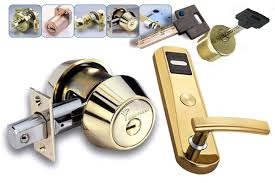
The businesses that come to us for this are fairly consistent: medical, dental and legal practices holding client records, pharmacies and clinics, self-storage operators, property managers running multi-tenant buildings around Davis Drive and Yonge, and light industrial sites near Highway 404 with tool cribs and stock cages worth protecting.
A restricted system also plays well alongside electronics. Plenty of sites run fob entry on the main door and restricted mechanical keys on everything behind it, which keeps the electronic budget down and still gives real key control. It is also what you fall back on when the power is out and the fob reader is dark.
How we set these up
Key systems across the region
We design and install restricted and master key systems for businesses around Newmarket. Survey and design are booked appointments; cylinder fitting is often done after hours so the building keeps working.
Frequently asked questions
Can a restricted key really not be copied?
Not at a hardware store, a kiosk or a self-service machine, because the blank is not sold to them. A patented key adds legal protection on top of the distribution control. A copy can only be cut by an authorised dealer against written authorisation from someone you have named. That is as close to uncopyable as mechanical keys get.
What does a restricted key system cost for a small office?
For six to eight doors with two key levels, expect roughly $900 to $1,900 all in — design, restricted cylinders and the first set of keys. Cylinders individually run $85 to $180 each. Keys afterwards are $18 to $32 for a change key and $25 to $45 for a master.
What happens if we lose a key later?
You call us, we check the register to see exactly which doors that key opened, and you decide whether to rekey that level. Because the blank cannot be copied, a lost key is far less urgent than with a standard keyway. Rekeying a single level runs $40 to $75 per cylinder affected.
How do I explain the hierarchy to my staff?
In plain terms: your key opens your area. Your manager key opens your whole department. The owner key opens everything. You do not need to explain the pinning, and you should not — the less detail circulating about how the system is built, the better. The written chart stays with the people who authorise keys.
Can we add doors to the system later?
Yes, provided the system was designed with expansion room, which is exactly what we build in at the design stage. Adding an opening later costs $110 to $210 including the cylinder and pinning it to your existing chart. Systems designed without headroom often cannot expand cleanly, which is the most common reason we get asked to redesign one.
Is a restricted system better than fob access control?
Different tools. Restricted keys give you control over duplication for a fraction of the price, with no power, batteries or subscription. Fob systems let you delete a person instantly and log who went where. Businesses with high staff turnover usually want fobs; businesses with stable staff and valuable contents often do better with restricted keys.
Will my existing locks work with a restricted system?
The lock bodies usually stay. What changes is the cylinder inside them, and most commercial lever sets, mortise locks and deadbolts accept a replacement cylinder in a restricted keyway. That keeps the cost down considerably. Occasionally a lock is too old or too unusual and the whole unit gets replaced.
How long does it take to set one up?
A survey and design for a small office takes a couple of hours plus a day or two to prepare the chart. Cylinders are then ordered, which is typically one to two weeks. Fitting six to eight cylinders is a single evening visit. Larger buildings are staged over several visits so nothing is left unsecured.
Related locksmith services in Newmarket
Take control of who holds your keys
Tell us how many doors you have and how many people carry keys. We will survey, design a chart and show it to you before anything is ordered. Call 866-820-1331.