
Lock Rekey Newmarket — Re-Pin the Cylinder, Keep the Hardware
Rekeying re-pins the cylinder already on your door so every old key stops working. The lock stays, the hardware stays, only the key changes. Most Newmarket houses are finished in under an hour.

Quick answer
A lock rekey means opening the cylinder and swapping the small brass pins inside so it accepts a new key and rejects every old one. The lock never leaves the door. In Newmarket a technician rekeys a cylinder in five to ten minutes, and a typical house is done in under an hour at $25 to $45 per cylinder plus the service call.
A lock rekey is the cheapest honest answer to the question “how do I stop the old keys from working?” Nothing gets thrown out. The deadbolt, the knob, the strike, the screws and the finish all stay exactly where they are. We take the cylinder apart, change the pin stack inside it, and hand you a new key that the old ones can no longer imitate.
People are often surprised by how mechanical it is. There is no software, no registration, no serial number to call in. It is brass pins, a spring, a plug and a few thousandths of an inch of tolerance. That is also why it is fast — a technician who does this every day can re-pin a standard Schlage or Weiser cylinder on your kitchen table in about six minutes.
This page is the how-and-what-it-costs page. If you are trying to work out whether your situation calls for a rekey at all — new tenant, lost keys, an ex-partner who still has a copy — read the scenarios that call for rekeying locks instead. If the hardware itself is worn out or ugly, see lock replacement and new hardware.
What actually happens inside the cylinder
Every pin tumbler lock is the same idea, whether it cost $19 at a big-box store or $290 from a security dealer.
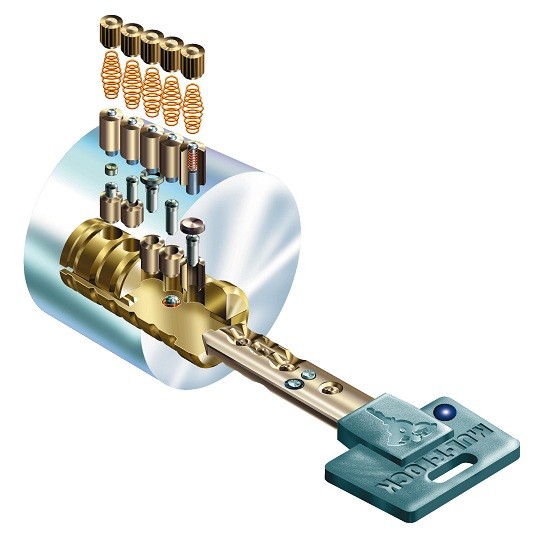
Inside the cylinder there is a rotating plug sitting in a fixed housing. Drilled through both are five or six vertical chambers. Each chamber holds a spring, a driver pin on top and a key pin underneath. With no key in the lock, the springs push the driver pins down so they straddle the gap between plug and housing. The plug is jammed. That gap is called the shear line.
The correct key lifts every key pin to exactly the right height so the join between key pin and driver pin lands flat on the shear line. Nothing is blocking the gap any more, so the plug turns and the bolt throws. A wrong key lifts one or more stacks too high or not high enough, something crosses the shear line, and the plug refuses to move.
Rekeying is simply changing which heights work. We pull the plug, tip out the old key pins, and drop in a different combination of key pins chosen to match a new key. The driver pins and springs usually stay. Reassemble, test, done. The old key now lifts the stacks to heights that no longer line up, so it spins uselessly or will not enter at all.
This is why a rekey is genuinely as secure as a new lock, provided the lock was decent to begin with. The security of a cylinder comes from its build quality, not from how recently it was pinned.
The rekey process, step by step
Identify the cylinder
We check the brand and keyway — Schlage C, Kwikset KW1, Weiser WR5, Sargent, Corbin, a euro profile, and so on. The pinning kit has to match the keyway. This takes about fifteen seconds and decides everything that follows.
Remove and open the cylinder
On a deadbolt, two through-bolts and the lock is off the door. On a knob or lever, a catch or a small hole releases the assembly. The cylinder retaining clip or cam comes off and the plug is pushed out with a follower — a plug-sized rod that keeps the top pins and springs from spilling out of the housing.
Re-pin to the new key
The new key goes into the plug and the technician reads which pin depth each chamber needs, then drops those key pins in and checks the tops sit dead flush with the plug. Anything proud of the surface will bind. This is the part that takes skill and about three minutes.
Reassemble and bench-test
The plug slides back in behind the follower, the clip goes back on, and the lock is turned twenty or thirty times with the new key before it goes anywhere near the door. Any hesitation means a pin is wrong and it comes apart again.
Refit and test on the door
Back on the door, we test locked and unlocked, with the door open and closed. A lock that works perfectly in the hand and stiffly on the door has an alignment problem, not a pinning problem, and we sort that while we are there.
Budget five to ten minutes per cylinder for the work itself once the technician is standing at your door. A front deadbolt plus a front knob plus a side door and a garage entry door — four cylinders — is a 40 to 50 minute visit including testing and cutting keys.
Keying several doors alike so one key opens everything
Most Newmarket houses arrive with a small pile of keys: one for the front deadbolt, a different one for the front knob, another for the side door into the garage, sometimes a fourth for the back slider or a garden gate. There is no reason for that. As long as the cylinders share a keyway, they can all be pinned to the same key.
Keying alike costs nothing extra beyond the per-cylinder rekey price. It is the single most appreciated thing we do on a house call, and it takes no additional time — the technician is pinning to one bitting instead of several.
- One key for the front deadbolt, front handleset, side door and garage entry
- Mixed brands can often still be keyed alike if the keyways are compatible — Weiser and Kwikset share KW1, for example
- Where a keyway will not match, we can swap that one cylinder rather than replace the whole lock
- Ask for a separate key on the garage or shed if you want to hand that one out without giving away the house
- Two to four cut keys are normally included; extras are a couple of dollars each
If you want the opposite arrangement — one master key that opens everything plus individual keys that open only their own door — that is a master key system, and it is a different pinning job with a different price.
What can be rekeyed and what cannot
Roughly nine out of ten residential locks in this area are rekeyable. The exceptions are worth knowing before you book.
- Rekeyable: Schlage, Weiser, Kwicksat-style KW1 cylinders, Kwikset, Defiant, most Taymor and most builder-grade knobs and deadbolts
- Rekeyable: euro profile and rim cylinders on newer builds and on many commercial glass doors
- Rekeyable: mortise cylinders in older Main Street homes and in commercial storefronts
- Rekeyable with the right kit: Medeco, Mul-T-Lock and other high security cylinders — but only by a dealer holding the restricted pins and the key card
- Not worth rekeying: a cylinder with a worn plug that lets a filed-down key turn it anyway
- Not rekeyable: anything seized with corrosion, cracked from a forced entry, or with a broken cam or tailpiece
- Not applicable: keypad-only and smart locks with no key override — those are re-coded, not rekeyed
If a technician opens your cylinder and finds the plug scored, the springs flattened or the housing chewed up, we will say so and quote the replacement instead of charging you for a rekey that will fail in six months. A worn cylinder is a strong argument for new hardware, and a corroded one on an exterior door usually is too.
Lock rekey prices in Newmarket
| Job | What it covers | Typical 2026 price |
|---|---|---|
| Service call | Travel to a Newmarket address, assessment, testing | $49 – $89 |
| Rekey, per cylinder | Re-pin one deadbolt, knob, lever or rim cylinder | $25 – $45 |
| Whole house, 4–6 cylinders | All exterior doors keyed alike, keys cut and tested | $180 – $300 |
| Extra cut keys | Additional copies beyond the two to four included | $3 – $8 each |
| High security cylinder rekey | Restricted keyway, dealer pinning kit, controlled key issue | $60 – $120 per cylinder |
| Euro or mortise cylinder rekey | Common on newer builds and older downtown homes | $35 – $60 per cylinder |
| Emergency after-hours rekey | Overnight, weekend or holiday attendance | Service call premium applies |
A rekey is almost always cheaper than replacement. Six cylinders rekeyed runs a few hundred dollars; six new deadbolts and handlesets supplied and fitted is comfortably over a thousand. If you want the two compared for your own doors, we have a page on rekeying versus replacing locks.
Ranges are typical for Newmarket and the surrounding towns. Overnight, weekend and statutory holiday call-outs carry a premium. A firm all-in price is confirmed on the phone before a technician is dispatched, and it does not change once we arrive.
Why book a rekey with us
Where we rekey locks
The van works out of Newmarket, so Glenway Estates, Stonehaven, Summerhill Estates, Woodland Hill, Huron Heights and Central Newmarket are all short runs. Anything off Yonge, Davis Drive, Mulock Drive, Leslie Street or Bayview Parkway is usually a 20 to 30 minute arrival.
We also cover the surrounding towns daily. There is no shopfront in those towns — the technician drives out from the Newmarket base, which is why we confirm an arrival window on the phone.
Frequently asked questions
How long does it take to rekey a lock?
Five to ten minutes per cylinder once the technician is at the door. A single deadbolt is done before you finish making coffee. A four-door house including cutting and testing keys is 40 to 50 minutes. The travel time to reach you is usually the longest part of the appointment.
Is rekeying as secure as buying a new lock?
Yes, if the lock itself is sound. Security comes from the grade and condition of the hardware, not from how recently it was pinned. A freshly rekeyed Grade 2 deadbolt is far more secure than a brand-new Grade 3 knob. The only thing a rekey does not fix is a lock that is worn, damaged or too weak for the door in the first place.
Can you rekey all my locks to one key?
Almost always, and at no extra charge. As long as the cylinders share a compatible keyway we pin them all to the same bitting. Where one lock uses a keyway that will not match the rest, we can swap just that cylinder rather than replace the whole lock, which keeps the cost down.
Do I need to buy anything before you come?
No. Rekeying uses the locks you already own. We bring the pinning kits, key blanks and the cutter. The only time you need to buy hardware is if a cylinder turns out to be worn or damaged, and we will tell you that before spending your money.
What does a lock rekey cost in Newmarket?
Expect $25 to $45 per cylinder plus a $49 to $89 service call. A typical four-to-six door house lands between $180 and $300 all in, keys included. High security and restricted cylinders cost more because the pins and blanks are controlled. The final number is confirmed on the phone before anyone is dispatched.
Can smart locks and keypad locks be rekeyed?
Only if they have a key override cylinder — many Schlage and Yale keypad deadbolts do, and that cylinder rekeys normally. A keypad-only lock has no pins to change; you change the user codes instead, which takes a minute and costs nothing. We can do both on the same visit.
Will the old keys still fit in the lock afterwards?
They may slide in, because the keyway shape has not changed, but they will not turn the plug. Some people find that reassuring and some find it unsettling. If you want the old blanks to be physically rejected as well, that means changing the cylinder to a different keyway, which we can quote at the same time.
Do you rekey commercial and rental properties?
Yes, regularly. Storefronts along Davis Drive and Mulock, small plazas, offices and rental units are routine work. For multi-unit buildings we usually recommend a keying schedule so units are individual but the caretaker holds one master. That is a master key system rather than a plain rekey.
Related locksmith services in Newmarket
Get your locks re-pinned today
Tell us how many doors and which brands are on them and we will give you a firm price on the phone. Call 866-820-1331 — 24 hours a day, every day of the year.