
Patio Door Lock Repair Newmarket
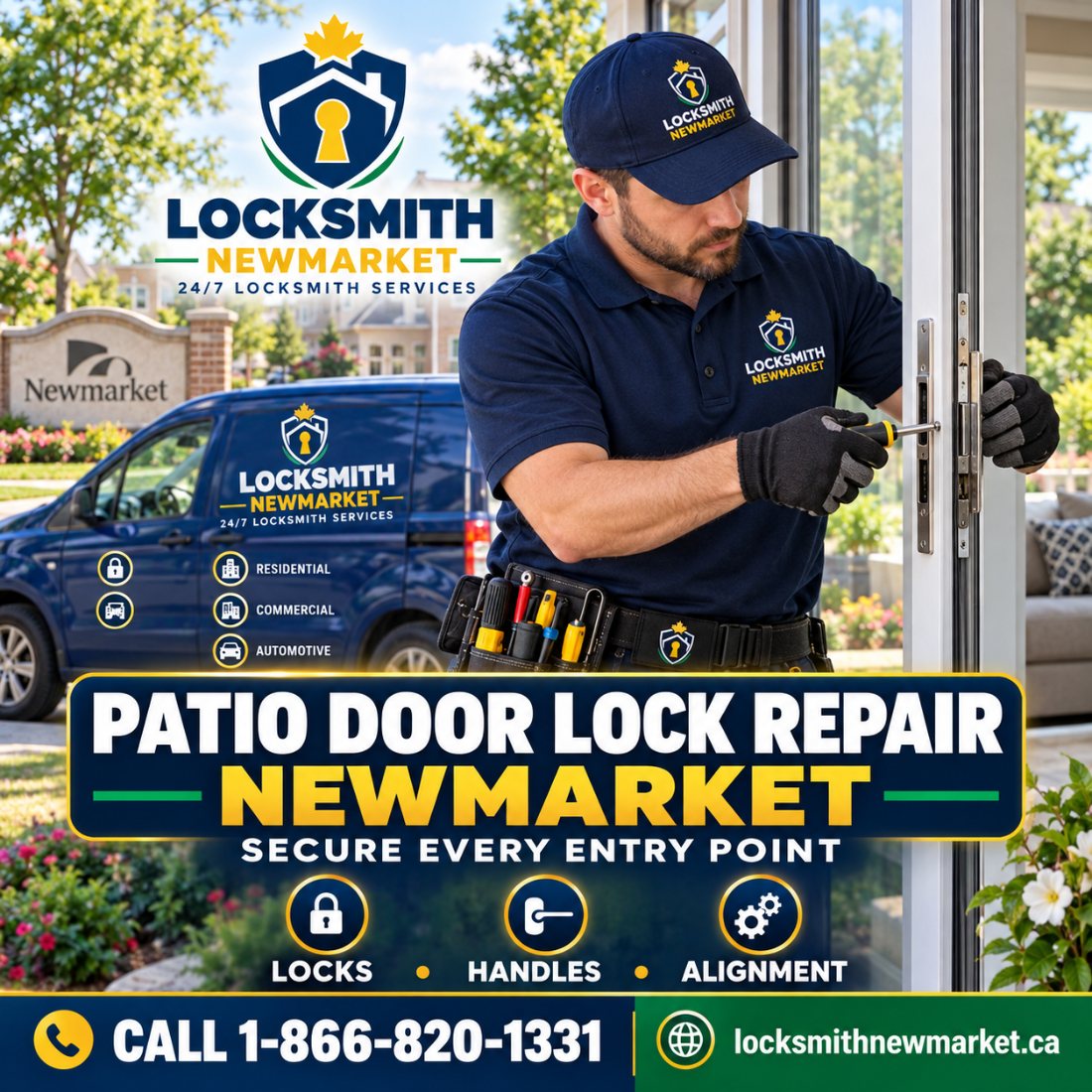
Sliding doors that will not latch, latch and still slide, or lift straight out of the track. Latches replaced, foot bolts fitted, panels realigned.
Quick answer
Patio door lock repair in Newmarket usually means one of three things: replacing a worn factory mortise latch, fitting an auxiliary foot bolt or pin lock so the panel cannot be levered or lifted, or realigning a door that has dropped on flat rollers so the latch no longer meets the keeper. Most visits run $140 to $280 and finish in under two hours.
The sliding patio door is the weakest opening on most Newmarket houses, and almost nobody thinks about it until it stops working. Ask for patio door lock repair in Newmarket and roughly two thirds of the calls turn out to be the same three problems, all of them fixable in a single visit.
The subdivisions built here between about 1993 and 2006 — Stonehaven, Summerhill Estates, Woodland Hill, the Copper Hills side — went up with aluminium-clad or vinyl sliders onto the back deck. Those doors are now twenty to thirty years old. The rollers have flattened, the frames have settled a few millimetres, and the little hooked latch that came in the box was never much of a lock in the first place.
What follows is what actually goes wrong, what a bar in the track does and does not do, and what it costs to make the door genuinely secure rather than merely closed.
The factory mortise latch, and why it fails
Nearly every residential slider uses the same design: a mortise latch buried in the edge of the moving panel, operated by a lever or thumb pull, throwing a small hooked tongue into a keeper screwed to the fixed frame. The hook is usually zinc pot metal. The spring behind it is thin. The whole assembly is about the size of a deck of cards.
Three things kill it. The spring fatigues, so the hook no longer snaps out fully and the door feels like it latches but does not. The pot metal hook cracks at the root, which is why people find a small grey fragment on the track. Or the keeper strips out of the frame because it is held by two short screws into thin extruded aluminium.
Replacement latches are still available for most Andersen, Milgard, Peachtree, Jeld-Wen and generic vinyl profiles, but they are not interchangeable. The measurements that matter are the faceplate length and screw spacing, the depth of the mortise pocket, and the height of the lever spindle above the latch. Get one wrong and the new latch will not sit flush. That is why a repair van carries several profiles and a set of templates rather than one universal part.
If the panel is otherwise sound, replacing the latch is the correct fix and it is a $140 to $240 job. If the panel itself is racked or the frame is corroded, we will tell you the door needs a glazier, not a locksmith.
A bar in the track is half a solution
Everyone has a broom handle or a cut length of dowel in the track. It is genuinely useful and it stops the door from sliding. It is also only half the problem, because it does nothing about the two other ways a slider opens.
The first is levering. A pry bar between the moving panel and the jamb, near the latch height, flexes a vinyl or thin aluminium frame enough that the little hook simply slips past the keeper. The bar in the track is irrelevant to that, because the door never travels sideways — it just pops.
The second is lifting. Sliding panels hang on rollers and sit in a track with clearance above them so they can be installed and removed. If that clearance is more than about a centimetre, the whole panel can be lifted, tilted at the bottom, and taken out of the frame with the latch still fully engaged. On a lot of Newmarket sliders you can do it with two hands and no tools. A bar in the track does not stop this either.
Anti-lift screws
Two or three pan-head screws driven into the upper track above the moving panel, adjusted to leave a few millimetres of travel. The panel can still roll; it can no longer be lifted clear. Cheap, invisible, and it should be on every slider in the province.
Foot bolt
A vertical bolt mounted at the bottom of the moving panel dropping into a drilled hole in the sill. It resists levering because the force is at the far corner from the latch, not beside it.
Auxiliary pin lock
A through-pin that passes horizontally through the moving frame into the fixed frame. Two positions, one closed and one at a four-inch vent gap, so the door can be left open for air but not opened further.
Keyed patio deadbolt
A surface-mounted keyed bolt where you want the door secured from outside as well, typically on a walk-out basement or a deck used as a main entrance.
The right combination for most houses is an anti-lift fix plus one auxiliary bolt, added on top of a working factory latch. That is a $180 to $300 visit and it converts the least secure door in the house into a reasonable one. If you want it keyed to the same key as the rest of the house, we can rekey the new cylinder to match on the same call.
When the lock is fine and the door is the problem
This is the diagnosis homeowners least expect and it is extremely common on doors of a certain age. The latch is in perfect condition. The keeper is solid. The door still will not lock unless you lift the handle, pull the panel toward you, or lean on it.
What has happened is that the rollers have worn flat. A slider hangs on two or four small wheels at the bottom of the moving panel, each on an adjustable screw. Twenty-five years of grit, sun and a hundred kilos of glass flattens them. The panel drops three or four millimetres. The latch hook, which needs to meet the keeper within about a millimetre and a half, now arrives low and catches on the lip instead of dropping in.
The fix is often just the adjustment screws — usually behind small plugs at the bottom edge of the panel — turned to raise the door back into square. Where the rollers are genuinely destroyed, the panel comes out, the roller assemblies are swapped, and it goes back in. That is a heavier job, two people on a wide door, and it lands at $220 to $400 with parts.
Either way, nobody should be buying a new lock for it. This is the same misdiagnosis we see on swing doors, where a drifting strike gets blamed on the deadbolt — the same reasoning applies over on our general lock repair page.
- Door has to be lifted or pulled before the latch will catch — roller height, not the lock
- Latch feels mushy and does not snap out — fatigued spring in the mortise latch
- Small grey metal fragment found in the track — the pot metal hook has broken
- Keeper wobbles or pulls out — stripped screws in thin frame, needs larger fasteners or a backing plate
- Panel lifts more than a centimetre in the track — fit anti-lift screws today
- Door rattles in wind when locked — worn latch engagement, usually fixable by moving the keeper a millimetre
Patio and sliding door lock prices in Newmarket
| Job | What it covers | Typical range |
|---|---|---|
| Mortise latch replacement | Correct profile latch, keeper aligned | $140 – $240 |
| Latch plus new keeper | Latch, heavy keeper, backing fasteners | $170 – $280 |
| Anti-lift screws fitted | Upper track screws set and adjusted | $60 – $110 |
| Foot bolt installed | Bolt fitted, sill drilled and sleeved | $130 – $220 |
| Auxiliary pin lock | Two-position pin lock through both frames | $120 – $210 |
| Keyed patio deadbolt | Surface bolt, keyed alike to the house | $180 – $300 |
| Roller adjustment | Panel raised back into square | $95 – $170 |
| Roller replacement | Panel removed, rollers swapped, refitted | $220 – $400 |
| Full security package | Latch, anti-lift, foot bolt, one visit | $300 – $520 |
Ranges are typical for a Newmarket address in 2026 and cover labour plus standard hardware. Overnight, weekend and statutory holiday call-outs carry a premium. A firm price is confirmed on the phone before anyone is dispatched.
Why this door matters more than the front door
Back decks in Newmarket subdivisions face fenced yards. Nobody on Mulock Drive or Bayview Parkway can see someone standing at your patio door, and the person standing there knows it. The front door is under a streetlight with a neighbour’s window on it; the slider is not.
The second reason is noise. A slider levered at the latch makes almost none. A front door kicked at the strike makes a very loud bang that carries down a quiet street.
The third is that people leave them unlocked. A door that needs to be lifted and shoved before the latch will catch gets left latched-but-not-locked, and eventually just closed. Fixing the mechanical annoyance is what actually makes the door get locked, which is worth more than any hardware upgrade.
If you are doing a full pass on the house, the slider belongs in the same visit as the garage man-door and the back entry. Those are the three doors that get skipped.
Why Newmarket calls us first
Sliding door work across Newmarket and the surrounding towns
Sliders are everywhere the subdivisions are, so this work runs right across Newmarket and out to Aurora, East Gwillimbury, Holland Landing, Sharon, Queensville, Keswick, Bradford and Mount Albert. Older Keswick and Georgina cottage-conversion sliders are a category of their own — often aluminium, often seized, and usually needing the panel out.
Frequently asked questions
How much does patio door lock repair cost in Newmarket?
Replacing the factory mortise latch is $140 to $240 with the part. Adding an auxiliary bolt or pin lock is $120 to $220. Anti-lift screws on their own are $60 to $110. A full package — new latch, anti-lift and a foot bolt in one visit — runs $300 to $520. After-hours and holiday calls carry a premium and the price is confirmed before dispatch.
My sliding door will not lock unless I lift it. What is wrong?
Almost certainly the rollers, not the lock. Worn rollers let the panel drop a few millimetres, so the latch hook arrives below the keeper and catches on its lip. Lifting the door momentarily restores the alignment. The fix is raising the panel on its adjustment screws, or replacing the roller assemblies if they are flattened past adjustment.
Is a bar in the track enough to secure a patio door?
It stops the panel sliding, which is useful, but it does nothing about the two other attacks. A pry bar at latch height flexes the frame and pops the hook past the keeper without the door travelling at all. And most panels can be lifted out of the track entirely, latch engaged, bar in place. Add anti-lift screws and one auxiliary bolt.
What are anti-lift screws?
Two or three pan-head screws driven into the upper track directly above the moving panel, adjusted so a few millimetres of clearance remain. The door still rolls normally. It can no longer be lifted high enough to clear the bottom track and be removed. It costs almost nothing in parts and closes off one of the two easiest ways into a house.
Can you fit a lock that lets me leave the door open a few inches?
Yes. A two-position auxiliary pin lock drills a second hole so the pin can be dropped either with the door closed or at a vent gap of roughly four inches. The door can be left open for air and cannot be pushed wider. It is a common request on bedrooms and walk-outs, and it runs $120 to $210 fitted.
Can a patio door lock be keyed to my house key?
A keyed patio deadbolt can be, yes — we cut the cylinder to your existing key on site, or rekey it along with the rest of the house so everything ends up on one key. The standard factory mortise latch is not keyed at all; it is operated only from inside, which is why keyed patio hardware is a separate add-on.
Do you replace the whole patio door?
No. We are locksmiths, not glaziers. We repair and replace the locking hardware, adjust or replace rollers, and secure the panel against lifting and levering. If the frame is racked, the glass seal has failed, or the panel itself is bent, that is a door replacement and we will tell you straight rather than fitting hardware to a door that cannot hold it.
How quickly can someone come out?
Response to a Newmarket address is typically 20 to 30 minutes and this work is normally same-day. If the door will not close or lock at all and the house cannot be secured, say so on the call and it is treated as an emergency, day or night.
Related locksmith services in Newmarket
Get the slider fixed properly
Call 866-820-1331. Tell us whether the door latches at all and whether it lifts in the track, and we can usually name the fault before we arrive.