
Keyless Entry Locks in Newmarket: Mechanical Pushbutton and Keypad
Not every keyless lock needs a battery, an app or a wifi network. Mechanical pushbutton locks, keypad deadbolts, sensible code management, and an honest look at which one belongs on which door.
Quick answer
Keyless entry locks in Newmarket fall into three families: purely mechanical pushbutton locks that need no power at all, battery keypad deadbolts, and networked smart locks. For a garage, a side gate or a commercial back door, a mechanical pushbutton lock is usually the better choice, because there is nothing to go flat and nothing to go offline.
Keyless entry has been sold so hard as a technology product that most people now assume it means an app. It does not. The oldest keyless locks in daily use in Newmarket have no electronics in them whatsoever, and some of them have been letting people through the same door for twenty-five years on nothing but a set of springs and a clutch.
That matters because the failure modes are completely different. A battery lock is convenient until the battery dies at minus twenty in a Bristol-London driveway in February. A mechanical pushbutton lock cannot go flat, cannot lose a network and cannot be locked out by a firmware update. It also cannot text you when the kids get home.
This page is about the keyless options that are not smart locks. If an app, remote access and an audit trail are what you are after, our smart lock installation page covers those properly, including cold weather behaviour and which model type to buy. What follows is the other half of the subject, and for a lot of Newmarket doors it is the better half.
The three families of keyless entry
Pick the family first. The model is a detail.
Nearly every keyless lock on the market falls into one of three groups, and they are far more different from each other than the marketing suggests.
Mechanical pushbutton
Five buttons, no power, no electronics. The code is set by mechanical tumblers inside the case and changed with a tool. Rated for hundreds of thousands of cycles. Nothing to charge, nothing to pair, nothing to update.
Battery keypad
An electronic keypad driving a motor in a deadbolt or lever. Multiple user codes, often a key override. Runs on four AA cells for roughly a year. No network, so nothing to hack remotely and nothing to configure.
Networked smart lock
A battery keypad plus wifi, Bluetooth or Z-Wave. Remote unlock, temporary codes, notifications, an activity log. Genuinely useful, and genuinely more to go wrong. Covered on our smart lock page.
What they share
All three remove the key from the equation for daily use. All three still need a properly aligned bolt and a strike plate screwed into the framing stud, or none of it means anything.
Confusing the families is what causes disappointment. People buy a networked lock for a detached garage with no wifi coverage, or a mechanical pushbutton for a front door where they wanted phone notifications. Neither lock is at fault.
Mechanical pushbutton locks: no batteries, no wifi, no app
A mechanical pushbutton lock is a small piece of engineering that deserves more respect than it gets. Behind the buttons is a stack of tumblers and a clutch. Pressing the buttons in the programmed combination aligns the tumblers so the clutch engages, and only then does turning the knob or lever retract the latch. Press a wrong button and the sequence is dead until you clear it. There is no power supply anywhere in the device.
Detached garages
The classic case. No wifi out there, cold in winter, and you want the door to open for a kid with no key and no phone. A mechanical pushbutton lever handles all of it and asks for nothing.
Side gates and pool gates
Outdoors, exposed, wet, and often at the far end of the property. Batteries and electronics hate that environment. A weatherised mechanical unit does not care.
Commercial back doors
Staff entrances, kitchen doors, receiving doors. Heavy duty Grade 1 pushbutton locksets take thousands of cycles a month, and the code can be changed the day someone leaves without touching a computer.
Interior and utility rooms
Server cupboards, mechanical rooms, medication cabinets in a clinic, storage rooms in a plaza unit. Restrict access without issuing another key that will need collecting later.
- No batteries means no dead lock in a Newmarket January, which is the single biggest argument for them
- Nothing to configure and nothing to connect, so anyone can be told the code over the phone
- Codes are changed with a change key or by taking the lock down, in about five minutes
- Most models carry a key override cylinder, which can be keyed to match the rest of your building
- Grade 1 commercial versions are built for very heavy traffic and last for many years
- The trade-off is one code for everyone, no user tracking and no remote anything
Most of them accept the code buttons in any order or in a set order depending on the model, and many allow two buttons pressed together as a single element, which raises the number of combinations considerably. Changing the code means taking the lock off the door, or on the better models, using a change key from the inside. It is a five minute job, not a menu.
Battery keypad deadbolts, without the network
The middle option is the one most Newmarket homeowners actually want and often overshoot. A plain battery keypad deadbolt gives you multiple user codes, a key override and no key to carry, for roughly half the price of a connected model and with a fraction of the setup. There is no hub, no account, no app and no firmware.
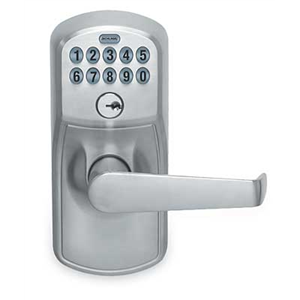
Practical points from fitting a lot of these. Buy one with a physical key override and keep a key somewhere sensible, because a lock with no mechanical way in is a lock that eventually strands you. Use lithium AA cells rather than alkaline for winter, since alkaline capacity falls off badly below freezing and a keypad on a north-facing door near Green Lane sees a lot of that. Change the cells on a schedule rather than waiting for the low battery warning, which on some models arrives with very little margin. And if the deadbolt has to be pulled or leaned on to throw, fix the door alignment before fitting a motor to it, because the motor is weaker than your wrist and it will stall where you would have pushed through.
Managing codes properly
A keyless lock is only as good as the discipline behind the codes.
The reason people move to keyless is that they are tired of chasing keys. Codes solve that, and then quietly create the same problem in a different shape, because a code that everyone knows and nobody changes is just a key that cannot be collected.
Give different people different codes where the lock allows it
On a multi-code keypad, the cleaner, the dog walker and the in-laws should not share the family code. When one of those relationships ends you delete one code instead of re-teaching the whole household.
Rotate on events, not on a calendar
Change the code when someone leaves, when a contractor finishes, when a tenant moves out, and after any period when the code was written down somewhere. Arbitrary quarterly changes mostly cause the code to end up on a sticky note.
Avoid the obvious numbers
Not the house number, not the year, not a birthday. And on a mechanical pushbutton, avoid a code that uses only the buttons that already look worn, because wear patterns are readable from a metre away.
Keep a written register on a business
One line per code: what it opens, who has it, the date issued and the date revoked. It takes minutes and it is what turns a keypad into an actual access control decision.
Clean the keypad occasionally
On any keypad, four shiny buttons among ten narrow the guesswork enormously. Wiping the whole pad down is a genuine security measure.
If you are managing more than a handful of codes across several doors, you have outgrown standalone keypads. That is the point where a proper access control system with fobs and a central user list becomes cheaper to run than the alternative.
When a mechanical keyless lock beats a smart lock
The honest comparison, including the cases where the mechanical lock loses.
We fit both, so we have no reason to sell you one over the other. The choice comes down to what the door is for and what you would actually use.
| Situation | Better choice | Why |
|---|---|---|
| Detached garage, shed or workshop | Mechanical pushbutton | Poor wifi coverage, wide temperature swings, and nobody needs a notification when the lawnmower is accessed. |
| Side gate, pool gate, exterior compound | Mechanical pushbutton | Fully exposed to weather. Electronics and standing water are a poor combination over several winters. |
| Commercial back door or staff entrance | Mechanical pushbutton, Grade 1 | Very high cycle counts, one shared code that changes when staff change, and no IT involvement at all. |
| Family front door, no rentals or staff | Battery keypad deadbolt | Multiple codes and a key override cover it. Connectivity adds cost you may never use. |
| Short-term rental or a property you do not live at | Networked smart lock | Temporary codes, remote revocation and an activity log are the entire point. See our smart lock page. |
| You want to let someone in while you are away | Networked smart lock | Nothing mechanical can do this. If it is a regular need, it settles the argument. |
| Rental unit with tenant turnover | Keypad plus a keyed cylinder | Change the code between tenants, and keep a mechanical key that can be rekeyed if a key goes missing. |
One more point that applies to all of them. Every keyless lock we fit still has a mechanical bolt going into a strike plate on a wooden jamb. The code is irrelevant if the frame gives way. Whichever family you choose, the box strike and three inch screws described on our deadbolt page are the cheapest part of the job and the part that does the most work.
Keyless entry lock prices in Newmarket
Typical 2026 supply-and-fit ranges. Mechanical pushbutton hardware costs more up front than a battery keypad and then costs nothing for years, which is worth factoring in on a commercial door.
| Job | What it covers | Typical price |
|---|---|---|
| Mechanical pushbutton lock supplied and fitted | Residential grade lever or knob set, code set on site | $320 – $600 |
| Heavy duty commercial pushbutton lockset | Grade 1 lever for a staff or back door, fitted and coded | $550 – $950 |
| Battery keypad deadbolt supplied and fitted | Keypad, key override, user codes set up | $220 – $420 |
| Fitting a keypad you supplied | Labour, alignment and code setup only | $90 – $160 |
| Code change and user code setup | Reprogramming, wear check, code list handover | $70 – $130 |
| Adding a keyed cylinder to match your other doors | Key override cylinder keyed alike with the house | $40 – $80 per cylinder |
Ranges are typical for Newmarket in 2026 and cover parts and labour on a standard door. Overnight, weekend and statutory holiday call-outs carry a premium. A firm price is confirmed on the phone before anyone is dispatched.
Why Newmarket calls us first
Keyless entry installs across Newmarket and the surrounding towns
Mechanical pushbutton work tends to be garages, gates and commercial back doors in the plazas off Davis Drive and Mulock Drive. Keypad deadbolts go mostly on family homes in Glenway, Summerhill, Woodland Hill and the newer builds towards East Gwillimbury. We cover the neighbouring towns from the same Newmarket base.
Frequently asked questions
Is there a keyless lock that does not need batteries?
Yes. Mechanical pushbutton locks contain no electronics at all. The code is set by tumblers inside the lock case and pressing the right sequence engages a clutch so the handle can retract the latch. They cannot go flat, cannot lose a network and are a very good choice for garages, gates and commercial back doors.
How do you change the code on a mechanical pushbutton lock?
It depends on the model. Better units have a change key that is inserted from the inside and lets you set a new combination in a couple of minutes. Simpler ones need the lock taken off the door so the tumbler pack can be reset. Either way it is a five minute job with no software and no reprogramming.
Are mechanical keyless locks secure enough for a business?
For a staff or back door, yes, provided you choose a Grade 1 commercial unit and manage the code. They are built for very heavy cycle counts and the code can be changed the day someone leaves. The limitation is that everyone shares one code and there is no record of who came through. Once that matters, you want access control instead.
What happens to a keypad deadbolt when the battery dies in winter?
On most models nothing dramatic, because there is a physical key override and often external contacts for a jump. The practical fix is prevention. Use lithium AA cells rather than alkaline, since alkaline loses a lot of capacity below freezing, and change them on a schedule rather than waiting for the warning.
Should I get a keypad lock or a smart lock?
If you only need to stop carrying a key and to give a few people their own codes, a plain battery keypad does it for around half the money and none of the setup. If you need to let someone in remotely, issue temporary codes or see an activity log, you need a connected lock. Our smart lock installation page goes through those cases.
How often should I change the code?
On events rather than on a schedule. Change it when a contractor finishes, when a tenant or an employee leaves, or after the code has been written down anywhere. Fixed quarterly changes tend to result in the code being written on a sticky note, which is worse than leaving it alone.
Can someone guess my code from the worn buttons?
On a heavily used keypad, yes, and it narrows the guesswork enormously. Four shiny buttons out of ten reduce a huge number of possibilities to a small one. Wipe the whole keypad down occasionally so all the buttons look the same, and avoid codes that use only obvious digits.
Can a keyless lock use the same key as my other doors?
Usually. Most keyless locks keep a mechanical override cylinder, and that cylinder can generally be pinned to match your front and back doors so one key still opens everything. We do it on the same visit. See rekeying locks for how keying alike works.
Related locksmith services in Newmarket
Tell us what the door is for and we will tell you which lock it wants
Garage, gate, back door or front entry, the right keyless lock is different for each. Call 866-820-1331 and we will work it out in two minutes.