
Kwikset SmartKey Rekey Newmarket
How SmartKey re-pinning actually works, when to do it yourself, when not to, and what a jammed cylinder costs to put right.
Quick answer
A Kwikset SmartKey rekey in Newmarket resets the cylinder to a new key in about thirty seconds using the SmartKey tool and the current working key. It is $75 to $130 for the first cylinder and $25 to $45 for each additional one on the same visit. A cylinder that jams mid-reset cannot be picked and usually has to be replaced.
SmartKey is the little pinhole next to the keyway on most Kwikset and Weiser locks, and it does something genuinely clever: it lets the lock be re-keyed to a brand new key in half a minute, without opening the cylinder, without pinning kits, and without any locksmith training.
A Kwikset SmartKey rekey in Newmarket is therefore one of the few locksmith jobs a competent homeowner can honestly do themselves. We will explain exactly how, because pretending otherwise would be silly. We will also explain the two situations where doing it yourself goes badly, because those are the calls we get.
And at the end there is a straight opinion on SmartKey security, which is more complicated than either its fans or its critics usually admit.
How SmartKey re-pinning actually works
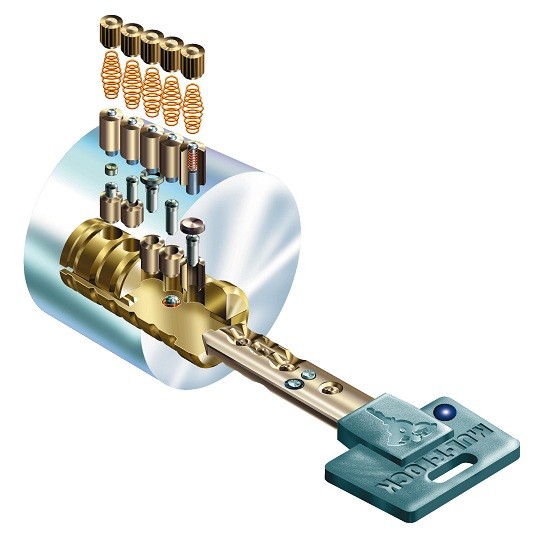
A conventional pin tumbler cylinder has stacks of pins of varying heights. Rekeying it means taking the plug out, swapping the bottom pins for a different set of heights and cutting a key to match. Fifteen minutes per cylinder and it needs a pinning kit and a key machine.
SmartKey does not use pins at that stage at all. Inside the plug is a set of sliders — small wafers riding in tracks — held in position against a sidebar. When the reset tool is pushed into the pinhole, it releases the sidebar and puts the sliders into a floating state. Turn the current working key ninety degrees, remove it, insert the new key, and turn it back. The sliders reposition themselves to the new key’s cut pattern and the sidebar re-engages. The lock is now keyed to the new key and the old one is dead.
That is the whole mechanism. It is a genuinely elegant piece of engineering and it is why a hardware store can sell you six locks keyed alike out of the box and let you rekey them all at home.
You need the current working key
This is the part people miss. SmartKey resets require the key the lock is currently set to. If you have lost every key, the reset is not available to you and the lock has to be picked or the cylinder replaced. Do not buy a SmartKey tool hoping it will solve a lost-key problem.
Insert the current key and turn it 90 degrees
A quarter turn clockwise, so the keyway is horizontal. The bolt does not need to be thrown; do it with the lock off the door or the door open so nothing binds.
Push the SmartKey tool fully into the pinhole
Firm, straight, all the way in until it stops. Then pull it out. There should be a small click. If the tool goes in soft or at an angle, stop — that is where jams start.
Swap keys and turn back
Remove the old key while still at 90 degrees. Insert the new key fully. Turn it back to vertical. Remove it and test. The old key should now do nothing at all — check that, do not assume it.
Done in order, with the right blank and the door open, it takes thirty seconds and works reliably. Done in a hurry on a stiff cylinder with a worn key, it is how cylinders die.
Doing it yourself versus having it done
Do it yourself when
You have all the current keys, the locks turn smoothly, the new keys are correctly cut Kwikset or Weiser blanks, and you can take the pressure off by working with the door open. One or two doors, fifteen minutes.
Call someone when
A key has been lost, a cylinder already feels gritty, the house is on more than one key family, or you are doing six or more doors and want them all keyed alike and verified.
The cost difference
A SmartKey tool is a few dollars and keys are cheap. A technician is $75 to $130 for the first cylinder plus $25 to $45 each after. A jammed cylinder is $130 to $230 to replace, which is where the saving disappears.
What we add
Keys cut on site to a fresh combination, every cylinder verified against the new key and the old key, plus non-SmartKey doors in the same house brought onto the same key.
The honest position: for two doors with all keys in hand, do it yourself. For a whole house, a rental turnover, or anything where a cylinder already feels notchy, the visit costs less than the mistake. Our general rekeying locks page covers the non-SmartKey side of the same job.
When a SmartKey cylinder jams mid-reset
This is the failure mode that brings people to us, and it is worth understanding because it is not random.
The sliders inside the plug have to travel cleanly along their tracks during the reset. Three things stop them. Grit and corrosion in an exterior cylinder that has taken five Ontario winters. A worn key whose cuts no longer register the sliders precisely. And a reset attempted while the cylinder is under load — turning against a binding bolt, or with the door closed and the bolt half thrown.
When they stop halfway, the sidebar cannot re-engage in either position. The result is a cylinder that no key will turn: not the old key, not the new key, nothing. And because the sidebar mechanism does not respond to picking the way a pin stack does, it cannot be picked open in that state either. It is genuinely stuck.
The fix is mechanical extraction. On a deadbolt with the door open, the lock comes off and the cylinder is pulled and replaced — $130 to $230 including the new cylinder, keyed to whatever key you want. If the door is locked shut with the jammed cylinder on the outside, it becomes a lockout and the cylinder is drilled, which adds to the bill. Which is the real argument for never attempting a reset with the door closed.
- Never reset with the door closed — always work with the door open or the lock off
- Use a properly cut new blank, not a worn copy of a copy
- If the cylinder already feels gritty, clean and lubricate before resetting, not after
- Push the tool straight and fully home; if it feels soft, stop
- Test the old key afterward and confirm it does nothing
- If the tool has been in and no key will turn, stop immediately — forcing it makes extraction harder
- Keep one known-good key per lock somewhere safe before you start
Is SmartKey secure? A straight answer
SmartKey has been criticised, some of it fairly. The sidebar and slider design has been shown to be vulnerable to certain destructive bypass techniques that a conventional pin tumbler would resist, and published research and demonstrations on that have been around for years. Kwikset has revised the mechanism more than once in response. It is not the strongest cylinder on the market and nobody should claim it is.
Against that, two things are true. SmartKey resists picking and key bumping better than the ordinary five-pin cylinders it replaced, because there is no pin stack to manipulate. And for the overwhelming majority of houses, the cylinder is not the weak point anyway — the frame, the strike screws, the patio slider and the ground-floor window are all easier than any cylinder on the door.
So: SmartKey is fine as builder hardware on a normal house, and its key control benefit is real and immediate — you can kill every outstanding key in thirty seconds, which is worth more in practice than a few points of theoretical attack resistance. If you want a cylinder that genuinely resists attack and controls key duplication, that is a high security cylinder with a restricted keyway, and it is a different budget.
What we would not do is spend money replacing working SmartKey cylinders with ordinary pin tumbler ones. That is a lateral move at best.
Getting the whole house onto one key
The most common reason people call about SmartKey is not a fault at all. It is that the front door, the back door, the garage man-door and the patio deadbolt are on three or four different keys, and everyone in the house is carrying a bundle.
Where every cylinder is SmartKey, this is fast: pick one key, reset each cylinder to it, test each one, done in under an hour for a typical house. Where some doors are SmartKey and some are conventional Kwikset or Weiser, the conventional ones get re-pinned by hand to the same cut pattern — same result, slightly longer. Where a door is Schlage, its cylinder has to be swapped because the keyway is physically different.
The end state is one key that opens everything, and every previously cut key dead. That is the same outcome as a full lock change at a small fraction of the cost, which is why we recommend it far more often than we recommend new hardware.
| Job | What it covers | Typical range |
|---|---|---|
| SmartKey reset, first cylinder | Reset, new keys cut, old key verified dead | $75 – $130 |
| Each additional cylinder | Same visit, keyed alike | $25 – $45 |
| Whole house, 6–8 cylinders | All doors onto one key, all tested | $220 – $420 |
| Jammed SmartKey cylinder replaced | Cylinder extracted and replaced, keyed to your key | $130 – $230 |
| Jammed cylinder with door locked shut | Drilled entry, cylinder replaced, keys cut | $210 – $340 |
| Mixed keyway conversion | Non-KW1 door converted to match | $120 – $220 |
| Clean and lubricate before reset | Cylinder flushed and dry-lubricated | $40 – $80 |
| Extra keys cut on site | Per key, cut and tested | $6 – $14 |
Ranges are typical for a Newmarket address in 2026 and cover labour plus standard hardware. Overnight, weekend and statutory holiday call-outs carry a premium. A firm price is confirmed on the phone before anyone is dispatched.
Why Newmarket calls us first
SmartKey work across Newmarket and nearby
SmartKey cylinders are standard on new builds, so this work concentrates in East Gwillimbury, Holland Landing, Sharon, Queensville and recent Newmarket infill, plus the Bradford subdivisions. Aurora and Stouffville see a lot of it too. The older the neighbourhood, the more likely a house is on conventional pin tumbler cylinders instead, which rekey just as easily by hand.
Frequently asked questions
How much does a Kwikset SmartKey rekey cost in Newmarket?
The first cylinder is $75 to $130 including new keys cut on site, and each additional cylinder on the same visit is $25 to $45. A whole house of six to eight doors runs $220 to $420 with everything on one key. A jammed cylinder that has to be replaced is $130 to $230. Prices are confirmed on the phone before dispatch.
Can I rekey a SmartKey lock myself?
Yes, if you have the current working key. Turn it ninety degrees, push the SmartKey tool fully into the pinhole and remove it, take out the old key, insert the new key and turn back. Thirty seconds. Do it with the door open so the bolt is not binding, use a properly cut blank, and test that the old key no longer works.
Can SmartKey be rekeyed without the original key?
No. The reset requires the key the lock is currently set to, because that key is what holds the sliders in a known position while the tool releases the sidebar. If every key is lost, the options are picking the lock open to get a working key made, or replacing the cylinder. Buying a SmartKey tool will not help.
Why did my SmartKey lock jam during the reset?
Usually grit or corrosion in the sliders, a worn key that does not register them precisely, or resetting while the cylinder is under load with the door closed. The sliders stop part-way, the sidebar cannot re-engage, and no key will turn — old or new. It cannot be picked in that state, so the cylinder has to be extracted and replaced.
Is SmartKey secure enough for my front door?
For a normal house, yes. It resists picking and bumping better than the plain five-pin cylinders it replaced, though published research has shown it is weaker than a conventional cylinder against certain destructive bypasses. In practice the frame, the strike screws and the patio door are all easier targets. If you want real attack resistance and key control, fit a high-security cylinder.
Can you put all my doors on one key even if they are not all SmartKey?
Yes. SmartKey cylinders are reset to the chosen key, conventional Kwikset and Weiser cylinders are re-pinned by hand to the same cut pattern, and any Schlage door gets its cylinder swapped because that keyway is physically different. The end result is one key for the whole house, done in a single visit.
How many times can a SmartKey lock be rekeyed?
There is no fixed limit and in practice most cylinders take many resets without trouble. What matters more than the count is condition — an exterior cylinder that has taken several Ontario winters accumulates grit in the slider tracks, and that is what causes jams. Clean and lubricate an older cylinder before resetting it rather than after.
Should I replace my SmartKey locks with regular ones?
Not usually. Swapping a working SmartKey cylinder for an ordinary five-pin one is a lateral move — you lose the thirty-second rekey and gain very little. If you genuinely want better security, the upgrade worth paying for is a high-security cylinder with a restricted keyway, together with a reinforced strike and three-inch screws into the stud.
Related locksmith services in Newmarket
One key for the whole house
Call 866-820-1331. Tell us how many doors and whether you still have a working key, and we will price the rekey on the call.